Muslim Brotherhood: Creation of the British and CIA Collaborators
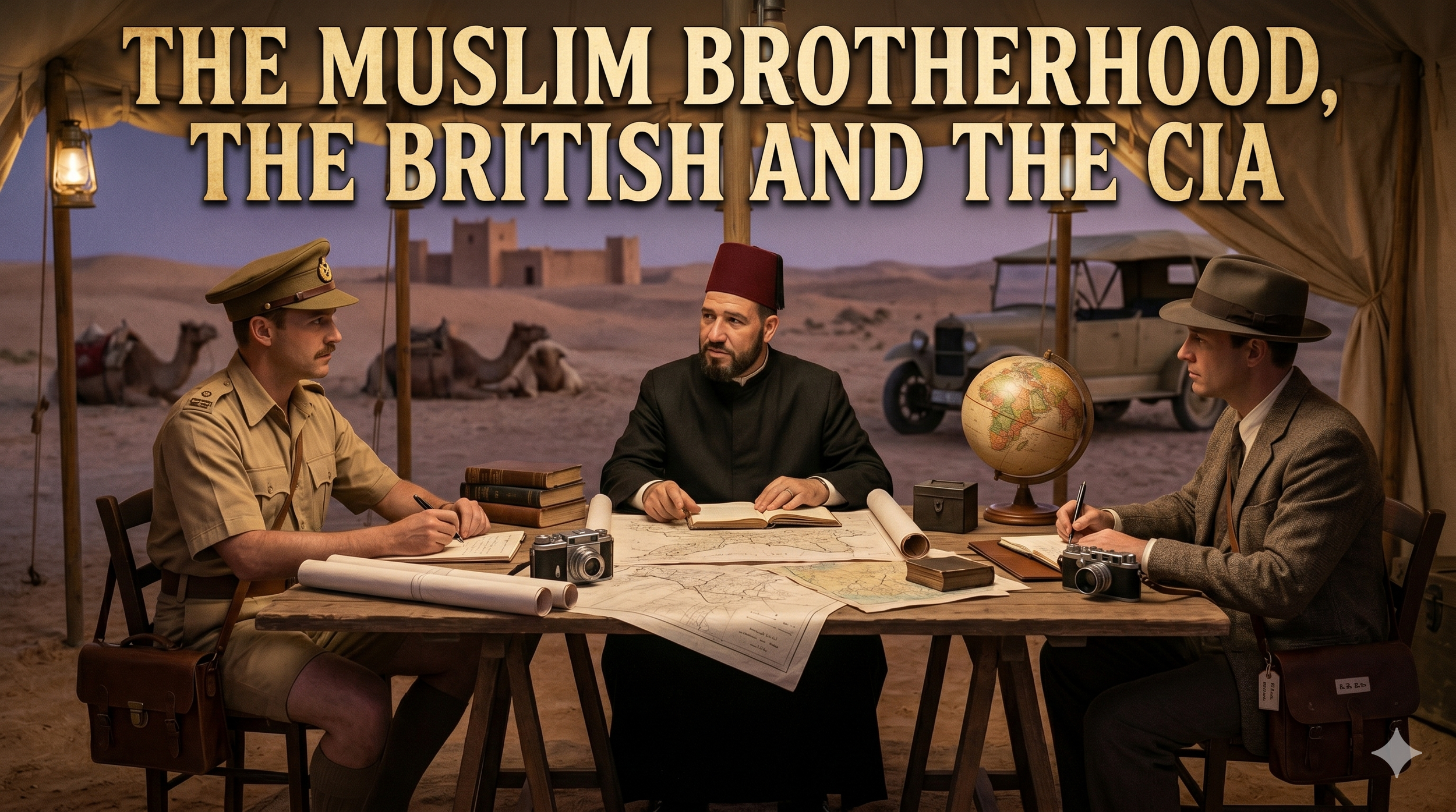
In historical research and political science, the relationship between Western intelligence agencies (both British and American) and the Muslim Brotherhood is a subject of extensive documentation.
However, rigorous academic literature draws a distinct line between tactical collaboration/covert funding (which is well-proven) and the claim that the Brotherhood was a "British creation" (which is generally classified by historians as an oversimplification or a conspiracy theory). Historically, the Society of the Muslim Brothers was founded independently in 1928 by Hassan al-Banna in Ismailia, Egypt, as a grassroots religious and social movement against British colonial influence (Lindstrom-Ives).
That nuance aside, there are seminal, peer-reviewed texts and deep historical archival studies by credible journalists and historians that outline exactly how Great Britain and the CIA interacted, funded, and collaborated with the Muslim Brotherhood during the 20th century.
The most credible sources on this topic, categorized by their specific focus, are detailed below.
1. On British Covert Funding and Tactical Collaboration
Secret Affairs: Britain's Collusion with Radical Islam by Mark Curtis (2010)
Mark Curtis, a British historian and foreign policy analyst, extensively utilized declassified British National Archives files to document the UK’s relationship with Islamist groups.
The Claim: Curtis presents archival evidence that in the 1940s, British officials viewed the Muslim Brotherhood as a useful counterweight to both the secular nationalist Wafd party and the growing Egyptian communist movement.
Key Evidence Cited: He documents that as early as 1941, British intelligence began tracking the group and subsequently made covert financial contributions to the Brotherhood. A British intelligence report from 1942 explicitly discussed financially supporting the Brotherhood to ensure they would not disrupt British war efforts. Curtis argues that while Britain did not create the group, they subverted and utilized it as an intelligence tool to maintain their imperial foothold.
The Society of the Muslim Brothers by Richard P. Mitchell (1969)
This remains universally recognized by academics as the foundational text on the early history of the Muslim Brotherhood.
The Claim: Mitchell documents the early financial interactions between the British Suez Canal Company and Hassan al-Banna.
Key Evidence Cited: Mitchell notes that in 1928, the British-controlled Suez Canal Company donated 500 Egyptian pounds to Al-Banna to help build the Brotherhood's first mosque in Ismailia. While Al-Banna accepted this money under the guise of an unconditional donation for religious purposes, this transaction forms the historical core of the "British subsidy" argument frequently cited by critics.
2. On Collaboration with the CIA during the Cold War
A Mosque in Munich: Nazis, the CIA, and the Rise of the Muslim Brotherhood in the West by Ian Johnson (2010)
Ian Johnson, a Pulitzer Prize-winning journalist, spent years combing through Western and German archives to trace how the CIA co-opted the Muslim Brotherhood during the Cold War.
The Claim: Johnson demonstrates how the United States government took over covert networks originally utilized by Nazi Germany, transforming a mosque project in Munich into a base for political warfare against the Soviet Union.
Key Evidence Cited: The book focuses heavily on Said Ramadan (the son-in-law of Hassan al-Banna and a key leader of the Brotherhood's international expansion). Johnson reveals declassified documents showing that the CIA heavily subsidized Ramadan's travel and operations in Europe during the 1950s. The CIA viewed the Brotherhood’s intense anti-communism as a strategic asset to deter Soviet expansion into the Middle East and to undermine secular Arab nationalist leaders like Egypt's Gamal Abdel Nasser.
Devil's Game: How the United States Helped Unleash Fundamentalist Islam by Robert Dreyfuss (2005)
Robert Dreyfuss, an investigative journalist specializing in Middle East foreign policy, provides a comprehensive look at how the United States utilized political Islam during the 20th century.
The Claim: Dreyfuss outlines how the CIA systematically collaborated with the Muslim Brotherhood from the 1950s through the 1970s.
Key Evidence Cited: He highlights specific tactical alliances, such as the 1953 meeting between U.S. President Dwight D. Eisenhower and a delegation of Islamic scholars at the White House—which included Said Ramadan. Dreyfuss also details how the CIA viewed the Brotherhood as a reliable street-level force to destabilize left-wing, socialist, and nationalist movements that threatened Western interests.
3. From the Inside: Intelligence Operational Accounts
Sleeping with the Devil: How Washington Sold Our Soul for Saudi Crude by Robert Baer (2003)
Robert Baer, a legendary former CIA case officer who spent decades on the ground in the Middle East, provides an insider perspective on how Western intelligence agencies utilized radical Islamic networks as geopolitical levers.
The Claim: Baer explores the deep roots of modern political Islam and traces how both U.S. and British intelligence services historically co-opted and utilized the Muslim Brotherhood during the Cold War.
Key Evidence Cited: He outlines how the West viewed the Brotherhood as a highly effective, ready-made bulwark against two major threats to Western interests: Soviet Communism and secular Arab nationalism (such as Egypt's Nasserism). Baer argues that by turning a blind eye to—and occasionally encouraging—the funding of fundamentalist groups to achieve short-term geopolitical goals, the West helped cultivate a volatile system that ultimately backfired.
See No Evil: The True Story of a Ground Soldier in the CIA's War on Terrorism by Robert Baer (2002)
This memoir details Baer's 21-year career in the Directorate of Operations and sets the critical operational context for how the agency viewed political Islam.
The Claim: Baer explains that during the Cold War, the CIA's obsession with countering the Soviet Union meant that any group opposed to Marxism was viewed as a potential asset.
Key Evidence Cited: He details how the agency routinely ignored the long-term ideological dangers of militant fundamentalist groups because they were focused entirely on short-term tactical advantages against Moscow, demonstrating the cynical, realpolitik nature of these historic intelligence collaborations.
4. Academic Summary of the Shifting Geopolitics
"Shifting Sands: The United States, Great Britain, and the Muslim Brotherhood, 1945–1954" by J. Perry (Global Politics Review)
This peer-reviewed historical paper explicitly tracks the transition of the Brotherhood from a British intelligence asset to an American intelligence focal point during the onset of the Cold War.
The Claim: The paper demonstrates that while the Muslim Brotherhood publicly campaigned against British colonial rule, both British and American intelligence agencies consistently attempted to co-opt their massive, highly organized infrastructure.
Key Evidence Cited: Perry notes that by 1945, the Brotherhood boasted roughly 500,000 members. During the transition of power from British hegemony to American primacy in the Middle East, Western intelligence operations continuously re-evaluated the Brotherhood—shifting from viewing them as an imperial threat to treating them as a covert weapon against communism.
References
Baer, R. (2002). See No Evil: The True Story of a Ground Soldier in the CIA's War on Terrorism. Crown.
Baer, R. (2003). Sleeping with the Devil: How Washington Sold Our Soul for Saudi Crude. Crown.
Curtis, M. (2010). Secret Affairs: Britain's Collusion with Radical Islam. Serpent's Tail.
Dreyfuss, R. (2005). Devil's Game: How the United States Helped Unleash Fundamentalist Islam. Metropolitan Books.
Farhat-Holzman, L. (2010). Johnson, Ian, A Mosque in Munich: Nazis, the CIA, and the Rise of the Muslim Brotherhood in the West. Comparative Civilizations Review, 63, Article 13.
Lindstrom-Ives, B. M. (2023). The Muslim Brotherhood: How its Troubled History Suggests that it Will Not merely Survive but Thrive in the Twenty-First Century. UVM ScholarWorks.
Mitchell, R. P. (1969). The Society of the Muslim Brothers. Oxford University Press.
Perry, J. (2016). Shifting Sands: The United States, Great Britain, and the Muslim Brotherhood, 1945–1954. Global Politics Review, 2(1), 20–33.