Ashkenazi Utopia
It is already widely recognized that one of the primary causes of the Democratic sweep of Congress and the Senate during the recent mid-term elections was the war in Iran and America’s relationship with Israel.[1] As global public opinion shifts because of the atrocities in Gaza, publicly acknowledged support from AIPAC has become a liability, that the notorious lobbying group has decided to disguise its funding mechanism. When combined with Donald Trump’s threat to cut off U.S. military financing, the external safety net is beginning to dissolve, revealing that the enterprise was never a self-sustaining society, but a heavily subsidized garrison state facing severe structural insolvency.[2]
Israel is at risk of civil war or state collapse, warns a classified CIA assessment, titled “Fracture From Within,” compiled by Israel experts in the CIA’s Red Cell, as years of genocide in Gaza and war in Lebanon and Iran deepen political, economic, and social fissures within the country.[3] The combined crises, reported The Telegraph, “plus the economic strain of rising military spending, potentially put Israel at risk of not just societal fracture but civil war, according to a classified Central Intelligence Agency assessment reported at the start of the month.”[4] One Tel Aviv resident explained to Gal Beckerman of The Atlantic, “If Bibi is elected, I’m not sure I’m going to stay here. And it’s enough that 100,000 people like me are leaving, and this country is toast.”[5]
The internal fractures tearing the state apart are not temporary policy disputes, but the structural manifestation of what historian Ilan Pappé, a prominent Israeli historian and professor at the University of Exeter identifies as the terminal "last phase" of the Zionist project. As noted by Pappé, in “The Collapse of Zionism”:
Hamas’s assault of October 7 can be likened to an earthquake that strikes an old building. The cracks were already beginning to show, but they are now visible in its very foundations. More than 120 years since its inception, could the Zionist project in Palestine – the idea of imposing a Jewish state on an Arab, Muslim and Middle Eastern country – be facing the prospect of collapse? Historically, a plethora of factors can cause a state to capsize. It can result from constant attacks by neighbouring countries or from chronic civil war. It can follow the breakdown of public institutions, which become incapable of providing services to citizens. Often it begins as a slow process of disintegration that gathers momentum and then, in a short period of time, brings down structures that once appeared solid and steadfast.[6]
What is unfolding is that Israel has been a geopolitical experiment fueled by messianic expectations, forged in a secular age, and whose grand exaggerations are collapsing under the weight of its own ideological contradictions. The mirage is evaporating, leaving open a stark reality: Israel will turn out to be an example of everything it was intended to transcend, just another Middle Eastern State.
Israel is a country that has gone from being a fairy tale of a refuge for a people who had endured centuries of unfair persecution, to the most disliked country in the world, for its brazen hypocrisy and willingness to perpetrate the same type of brutality it pleaded the international community for protection from in 1948.[7] For decades, this political fallout would have been unthinkable, shielded by the soaring moral reputation the state initially cultivated. In its early history, Israel thrived on an international stature envied by other nations—projected and accepted as a heroic sanctuary of Holocaust survivors making the desert bloom, a pioneering democracy, and an untouchable moral beacon of Western enlightenment.
Yet this myth hides a harsher political reality. Stripped of its diplomatic armor and examined through history, the state is revealed as a European-conceived utopian project rooted in messianic ambition, trying to sustain itself on soil and among a population foreign to its original architects.
Historically and sociologically speaking, when a movement attempts to immanentize an eschatological ideal or force a utopian blueprint onto human reality—fueled by the manic expectation of divine intervention and the desperate gamble for a miracle—it almost invariably collapses under the weight of its own internal contradictions. History offers precedents for this kind of ideological and religious design, providing structural mirrors to the modern experiment. From the European-conceived Crusader States of the Levant—established between 1099 and 1291 as armed Catholic enclaves intended to secure holy sites through permanent military occupation and external resupply, only to collapse back into regional gravity once European priorities shifted—to millenarian enclaves like the Anabaptist Münster Rebellion of 1534–1535, which sought to establish an absolute earthly New Jerusalem. Similar trajectories marked the Jesuit Reductions of Paraguay from 1609 to 1767, designed as isolated, semi-theocratic Christian commonwealths, and Calvinist Geneva from 1541 to 1564, which attempted to construct a disciplined city of God governed by divine law as an ideological sanctuary for European Protestants.
Yet the Zionist project remains uniquely charged, resting upon two millennia of diasporic Jewish liturgy centered on the prophetic return, the advent of the Messiah, and the eventual redemption of the land— an expectation reinforced by Christian restorationist theology and eschatology in the Islamic world. Far from being an isolate fantasy of a fringe few, the sheer magnitude of these converging anticipations absorbed much of the political upheavals of modern times, precipitating massive geopolitical reorganizations, United Nations sanction for statehood, and decades of relentless conflict fought directly by the state and through proxy military interventions on its behalf by Western superpowers.
To understand how this experiment reached its current breaking point, we must look back at its origins in nineteenth-century Europe. The intellectual founders of political Zionism were men steeped in the European nation-state tradition. At a time when European powers were carving up the globe and defining nations by exclusive ethnic boundaries, these leaders looked at the rising tide of European antisemitism and concluded that Jewish survival required mirroring the European model: a sovereign, militarized ethno-national state. As historian Avi Shlaim documents in The Iron Wall, this foundational strategy was built on realpolitik and colonial-style calculations.[8] The architects operated under the assumption that an alien political body could be permanently transplanted into an existing Middle Eastern ecosystem through superior force, organizational discipline, and the patronage of outside empires.
Beneath this secular European political machinery pulsed an ancient messianic teleology. The return to Zion, the rebuilding of historical kingdoms, and the divine reclamation of ancient borders were powerful religious motifs. As Shlomo Sand demonstrates in The Invention of the Jewish People, secular nationalist leaders selectively stitched together and retroactively fabricated an unbroken, homogenous ancient history to give a modern territorial project the moral weight of divine mandate.[9] This created an unresolvable internal contradiction from day one: the project was driven by a religious, apocalyptic yearning, yet seeking to appeal for sympathy from the liberal values of the secular, Western enlightenment.
As Ian Lustick demonstrates in For the Land and the Lord: Jewish Fundamentalism in Israel, this internal takeover was operationalized through the systematic institutional capture of state apparatuses by messianic and fundamentalist vanguards.[10] Rather than remaining a marginal fringe ideology, this movement infiltrated the foundational machinery of the state, including the World Zionist Organization's Settlement Division, regional planning councils, ministerial directorates, and religious authorities like the Chief Rabbinate and municipal religious councils. This institutional capture gave rise to what Pappé identifies as the "State of Judea,” which developed among the settlers of the occupied West Bank, who are locked in an irreconcilable civil clash with the "State of Israel," the middle-class Ashkenazi elite and their descendants. The "State of Judea” seeks to transform Israel into an explicit theocracy spanning historical Palestine, pursuing the reduction of the Palestinian population to a bare minimum and contemplating the demolition of al-Aqsa to construct a Third Temple in fulfillment of Bible prophecy.
For decades, Western political discourse insulated the state behind the trope of being the "only democracy in the Middle East," setting it apart from a region routinely dismissed as a monolith of autocracy, religious fundamentalism, and tribal decay. But as Israel Shahak and Norton Mezvinsky unmask in Jewish Fundamentalism in Israel: Roots and Pragmatism, this diplomatic shield was a cruel inversion of internal realities.[11] Shahak and Mezvinsky dissect how the rhetoric of secular democracy served as an outward diplomatic facade, while traditional, messianic, and fundamentalist currents steadily captured the state's educational systems, settlement infrastructure, and military command ranks from within.
New Jew
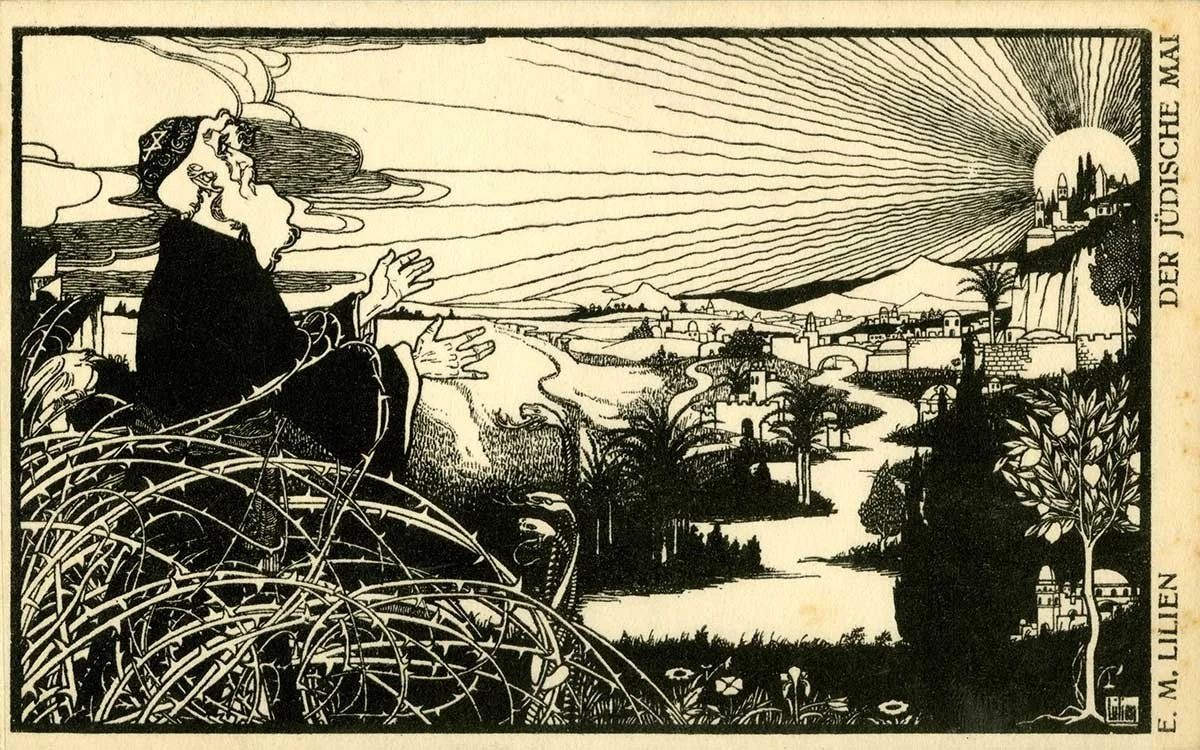
E.M. Lilien's famous 1902 Art Nouveau illustration, titled Der Jüdische Mai ("The Jewish May"), is a powerful visual metaphor for the transition from the "Exile/Diaspora Jew" to the "New Jew" envisioned by early Zionists.
The founding generation of leaders—including David Ben-Gurion, Golda Meir, Menachem Begin, and Yitzhak Shamir—were born in the Russian Empire or Europe (Poland, Ukraine, Belarus) and immigrated to Mandatory Palestine during the Zionist waves of aliyah. Of them and their descendants, who represent the “State of Israel,” explains Pappé:
Make no mistake, their advocacy of ‘liberal democratic values’ does not affect their commitment to the apartheid system which is imposed, in various ways, on all Palestinians living between the Jordan River and the Mediterranean Sea. Their basic wish is for Jewish citizens to live in a democratic and pluralist society from which Arabs are excluded.[12]
Imbued with nineteenth-century nationalist philosophy, Continental legal structures, and European racialized frameworks, this vanguard viewed themselves as the bearers of Western enlightenment destined to civilize what they perceived as a backward Levant. To understand the foundational contradiction of the Zionist project, one must first confront the intellectual blueprint of its ideological vanguard: the creation of the "New Jew." This blueprint traced its lineage to the European fin-de-siècle obsession with forging a "New Man," adopting a philosophical framework synthesized from Nietzsche's vitalist power, the intellectual co-founding of political Zionism by Max Nordau alongside Theodor Herzl—through which Nordau formulated his diagnosis of physical and moral degeneration and championed "Muscular Judaism" to physically redeem the diaspora Jew—alongside Georges Sorel’s revolutionary syndicalist myth of violence, Filippo Tommaso Marinetti’s technocratic militarism, and Maurice Barrès’s cult of soil and collective roots.[13]
When authoritarian and fascist political cultures swept Europe in the 1920s and 1930s, certain factions within Zionism—most notably Revisionist Zionism led by Ze'ev Jabotinsky—shared aesthetic overlaps with European right-wing nationalisms, admiring unyielding military strength, hierarchical discipline, uniform culture, and subordination to the sovereign state.[14] The Zionist leadership arrived from Central and Eastern Europe steeped in these nineteenth-century nationalist philosophies, Continental legal structures, and European racialized frameworks, viewing themselves as the vanguard of Western enlightenment bringing civilization to a supposedly backward Levant.
By anchoring its foundational architecture in European ethnic nationalism, Zionism transformed Jewish identity from a religious affiliation into a rigorous, state-enforced ethno-national category. The creation of an ethnically defined state emerged as an attempt to escape the lethal persecution of European nation-states that defined citizenship through blood and soil—culminating in the Nazi doctrine of Blut und Boden and the genocidal pursuit of a Judenrein Germany for Germans alone. Yet rather than rejecting this exclusionary paradigm, political Zionism inverted it, establishing a state where national belonging, land allocation, and legal rights were permanently yoked to a specific ethno-national identity.
Yet the irony of this ethno-national construct quickly turned inward, as a political movement founded to rescue Jews from European antisemitism established a sovereign secular monopoly on defining who a "Jew" is. Armed with this exclusive authority, the European-descended Ashkenazi vanguard subjected its non-European Jewish majority to systematic discrimination, cultural erasure, and structural paternalism upon their arrival. The historical disconnect began with a deep psychological and demographic chasm. While Ashkenazi Jews were forged in the fires of European racial antisemitism, culminating in the industrial genocide of the Holocaust—a trauma leaving an unyielding psychological mark of perpetual existential siege—Mizrahi Jews had spent centuries fully integrated into regional ecosystems across Iraq, Morocco, Yemen, Iran, Egypt, and Syria, where their music, culinary traditions, modes of worship, and spoken languages were bound to Arab and Islamic civilization. Thriving under Islamic governance, their historical status was defined by dhimmitude: a protected yet subordinate status involving communal autonomy alongside social and legal restrictions. While this relationship experienced periodic friction and political instability, it bore no resemblance to the biological, genocidal annihilationism of modern European nation-states.
When hundreds of thousands of Mizrahi Jews arrived during the massive immigration waves of the 1950s, the European-descended elite viewed them not as long-lost brothers returning home, but as a demographic and cultural threat. As Hannan Hever, Yehouda Shenhav, and Pnina Motzafi-Haller document in The Mizrahi Era in Israel, the state immediately instituted a program of internal colonialism.[15] Rather than accommodating this massive influx, the Zionist leadership sought to press these newcomers into their pre-existing ideological mold: the Tzabar—the hardened, European-forged "New Jew" conceptualized decades earlier, which demanded the complete severance of diasporic identity.
In practice, this meant incoming Middle Eastern Jews were subjected to forced secularization, cultural sanitization, and institutional paternalism. As Sami Shalom Chetrit analyzes in Beyond Backwardness, the state systematically dismantled traditional Mizrahi communal structures, suppressed their Arabic dialects and liturgical traditions, and marginalized their spiritual leadership.[16] Their history was rewritten as a narrative of rescue from perpetual degradation, painting them as passive objects of European benevolence rather than active participants in a shared heritage.
This cultural degradation was matched by geographic and economic subordination. As Hannan Hever demonstrates in The Twilight of Internal Colonialism, incoming Mizrahi families were not integrated into thriving metropolitan cores or socialist collective agricultural communes known as kibbutzim.[17] Instead, they were dumped into transit camps (Ma'abarot) before being moved to peripheral "development towns" established deliberately along dangerous desert borders and geographical peripheries—places like Dimona, Ofakim, Kiryat Shmona, and Beit Shemesh.
These peripheral settlements served a dual purpose: they acted as a human buffer zone to secure borders against neighboring states, and they functioned as an immobile, cheap labor reserve for the central Ashkenazi economy. Stripped of capital, education, and political leverage, non-European Jews were funneled into manual labor, textile factories, and low-wage municipal services. They discovered that a state built in the name of Jewish liberation had locked them into a domestic hierarchy where European extraction replaced European persecution.[18]
Daddy Issues

This family portrait from the early 1950s features Israeli historian Benzion Netanyahu and his wife Tzila, alongside their young sons Benjamin (left), who would become Israel's Prime Minister, and Yonatan (right), the future IDF hero of Operation Entebbe.
When early Zionist ideologues conceptualized the Tzabar and the "New Jew," their stated objective was to dismantle the vulnerable, diasporic archetype—the persecuted, intellectual ghetto dweller who survived through accommodation—and replace it with a sovereign, physically unyielding warrior who commanded the soil. Yet under Benjamin Netanyahu, this archetype underwent a dark, lethal mutation. Prominent Israeli journalists and biographers, including Anshel Pfeffer (Bibi: The Turbulent Life and Times of Benjamin Netanyahu) and Ben Caspit (The Netanyahu Years), trace this trajectory directly to the overwhelming psychological shadow cast by his father, Benzion Netanyahu—a towering, uncompromising figure of Revisionist Zionism who served as personal secretary to Ze'ev Jabotinsky. Benzion’s scholarship and worldview were defined by an unshakeable pessimism regarding non-Jewish populations and the permanence of antisemitism.[19]
Biographers and political analysts emphasize three core tenets that Benzion instilled in his sons. First, regarding the inescapable threat, Benzion argued that Jewish existence—whether in the diaspora or within a state surrounded by hostile powers—was a perpetual state of existential siege, maintaining in his historical writings on the Spanish Inquisition that gentile hatred of Jews was entirely unalterable by assimilation, conversion, or liberal diplomacy.[20] Second, concerning the need for unyielding strength, because the world is permanently hostile, Benzion believed that any display of weakness, diplomatic compromise, or reliance on international goodwill was a fatal error, requiring a militarized, iron-willed garrison state that trusted no external allies entirely.[21] Third, regarding the burden of the patriarchal shadow, Benjamin Netanyahu's older brother, Yonatan (Yoni) Netanyahu, was killed during the 1976 Entebbe raid, becoming Israel's most celebrated national martyr. Benzion’s grief was monumental, and analysts like Pfeffer and Caspit note that Benjamin spent his life trying to measure up to an idealized, fallen older brother and an intensely demanding, intellectually rigorous father who viewed political diplomacy with deep suspicion.[22]
When observers and critics—such as political sociologist Uri Ben-Eliezer (The Making of Israeli Militarism) and historian Tom Segev—examine Netanyahu through the prism of this family dynamic, they argue that his governance functions less as pragmatic statecraft and more as a continuous, compulsive validation test.[23] As Ben-Eliezer and Segev have observed, Netanyahu’s deep-seated anxiety over projecting weakness transformed the state's security apparatus into an extension of a personal psychological defense mechanism; rather than adapting to a changing geopolitical reality, he weaponized his father's doctrine of permanent siege to subordinate national strategy to his survival, turning the "New Jew" archetype into a paranoid garrison commander who views every diplomatic opening as a trap and every compromise as a fatal betrayal.[24] Framed through these deeply personal dynamics—what can only be poignantly characterized as national governance dictated by profound generational "daddy issues"—Netanyahu stands as the ultimate tragic irony of the Zionist project. Suffering from an insatiable, lifelong compulsion to prove his strength in the shadow of his father and his fallen brother, he hijacked a collective nation-building enterprise into a personal survival mission, bulldozing the very soft power, diplomatic goodwill, and bipartisan frameworks that made the improbable state possible in the first place.
This deep-seated need to project omnipotence led Netanyahu to bulldoze decades of painstaking, quiet diplomatic cultivation by his predecessors. Convinced of his own tactical mastery, he mistook the structural, bipartisan U.S. support built over generations for a reflection of his personal diplomatic finesse.[25]
This megalomania manifested through systematic interventions in American political architecture. First, through direct interventions in U.S. partisan politics, the most glaring rupture occurred in March 2015 when Netanyahu accepted an invitation from congressional Republicans to address a joint session of Congress—engineered entirely without the knowledge or consent of sitting Democratic President Barack Obama—to launch a direct public offensive against the Iran Nuclear Deal (JCPOA).[26] By openly aligning himself with one American political party against the executive branch of another, Netanyahu transformed support for Israel from a shared national value into a domestic wedge issue, while dozens of congressional Democrats boycotted the speech, signaling a profound psychological turning point where partisan division over Israeli leadership became explicit.[27] Second, through the weaponization of conservative alignment rather than maintaining equidistant relations across the American political spectrum, Netanyahu doubled down on an overt alignment with the U.S. Republican party, particularly during the Trump administration.[28]
This strategy yielded short-term diplomatic payoffs—such as the relocation of the U.S. embassy to Jerusalem and the recognition of the Golan Heights—but it alienated the Democratic base, turning Israel into a toxic symbol for progressive and moderate Democrats alike and severing deep historical ties with traditional liberal-Zionist constituencies in the U.S.[29] Third, regarding the dismissal of democratic norms and diplomatic pushback, when liberal and moderate American lawmakers—including staunchly pro-Israel Democrats—raised concerns about settlement expansion, human rights violations, or the erosion of Israeli democratic institutions such as the 2023 judicial overhaul push, Netanyahu’s government routinely dismissed these critiques as illegitimate interference.[30] By publicly rebuffing bipartisan congressional delegations and treating critical feedback from American lawmakers as hostility, his administration signaled that Israel expected unconditional financial and diplomatic backing without accountability, alienating pragmatic allies who wanted to maintain support for the state while opposing its governance.[31]
The breathtaking arrogance underpinning this strategy was captured in a 2001 leaked video, filmed without his knowledge during a meeting with West Bank settlers, where Netanyahu boasted about how easily he manipulated Washington: "America is a thing you can move very easily, move it in the right direction. They won't get in the way."[32]
When faced with mounting legal peril—culminating in his formal indictment on corruption charges across three major probes, specifically Case 1000 involving illicit luxury gifts from billionaires, Case 2000 revolving around illicit quid-pro-quo media deals with the publisher of Yedioth Ahronoth, and Case 4000, the Bezeq-Walla affair where regulatory favors worth hundreds of millions were allegedly traded for positive Prime Ministerial coverage on a major news site—Netanyahu engineered a desperate political survival strategy.[33] To insulate himself from accountability and maintain power, he dragged the nation into unprecedented political polarization, attempting a sweeping judicial overhaul that triggered massive nationwide protests.[34]
To sustain his governing coalition, he welcomed the most dangerous fringes of Israeli politics into the core of state power, elevating radical figures like Itamar Ben-Gvir and Bezalel Smotrich.[35] By subordinating the structural integrity of the nation to his personal political survival, Netanyahu stripped away the external diplomatic armor of the state.[36] His failure to understand why his complete disregard for public opinion and international norms alienated global allies laid bare the fatal structural contradictions of the garrison state, proving that his ego became the ultimate solvent of the Zionist project.[37]
Start-Up Nation

Israel is widely championed as a "Start-Up Nation" because its dense, venture-backed tech sector and high-tech innovation hubs were heavily catalyzed by elite military intelligence units—such as Unit 8200—acting as an indigenous technical incubator.
The convergence of the muscular Zionist ethos, the archetype of the "New Jew," and the structural evolution of the Israel Defense Forces (IDF)—a transformation weaponized and personalized by Netanyahu to subordinate national survival to his own political preservation—reveals how deeply ideology can dictate military doctrine and technological design.[38] As the state confronted prolonged regional conflict, conventional manpower constraints, and the political costs of high casualty rates, the military leadership looked to technology as the ultimate guarantor of security.[39] This operational shift manifested as what critics and military analysts term the "cult of technology"—the belief that absolute qualitative superiority, automated signals intelligence (SIGINT), and cyber-surveillance could substitute for political resolution or compromise.[40] Rather than relying solely on infantry boots on the ground, the muscular ethos was refocused into mastering the digital domain.[41] Being strong no longer meant just physical combat readiness; it meant dominating the electromagnetic spectrum, owning the code, and exercising algorithmic oversight over occupied territories.[42]
For decades, international boosters and state ministries have celebrated Israel as a "Start-Up Nation," proving it to be an organic economic triumph, projecting an outward image of high-tech modernity to show that a transplanted Western economy could lead the global digital frontier.[43] Yet this glossy narrative of venture-backed innovation obscured underlying structural dependencies, extreme stratification, and a macroeconomic design anchored in a militarized state framework.
The material engine driving this success was forged through the totalizing framework of a militarized society. As documented by Baruch Kimmerling in The Militarization of Israeli Society, military service functions not merely as a defensive necessity, but as an absolute arbiter of social mobility, civic belonging, and national identity.[44] This technological-military nexus is unmasked in analyses such as “The IDF's Cult of Technology: The Roots of the Security Disaster” (American Affairs), showing how an over-indexing on automated signals intelligence, cyber-surveillance, and technological systems created an indigenous military-industrial complex designed for strategic self-reliance.[45] This complex operated as the original state-subsidized incubator, funding research, testing capabilities on occupied peripheries, and establishing infrastructure later repurposed for the civilian digital economy. Building on this foundation, the high-tech boom emerged not as decentralized market miracle, but as an insular, state-engineered intelligence enclave. As explored in Dark Sides of the Startup Nation (edited by Shireen Hassim, Uri Ram, and Noam Yoran), young conscripts are funneled through elite intelligence units like Unit 8200 and technological tracks under extreme operational pressure, serving as a pre-vetted, state-subsidized training ground that transfers public infrastructure directly into private, often foreign, hands.[46]
The incubation cycle begins before military service even starts.[47] Through rigorous nationwide screening, the military identifies computer science, mathematics, and engineering prodigies at age 17 or 18.[48] Once conscripted into units like Unit 8200, these young soldiers (typically aged 18 to 21) are placed under extreme, high-stakes operational pressure.[49] Rather than undergoing rote military drilling, they spend their mandatory service solving unprecedented engineering problems, managing massive data-mining architectures, writing offensive or defensive cyber-code, and processing real-time signals intelligence.[50] The military effectively provides an accelerated, real-world engineering bootcamp that outpaces any traditional university curriculum.[51]
Investigative tracking platforms like Open Intel document that Palantir actively recruits high-level, veteran personnel directly out of Unit 8200 to staff its specialized engineers and field operations teams.[52] Founded in 2003 with early backing from In-Q-Tel—the venture capital arm of the CIA—by a coterie led by Peter Thiel and Alex Karp, Palantir builds enterprise data-integration and decision-making software platforms designed to ingest massive, disparate data streams for military, intelligence, and corporate surveillance applications.[53] Unlike multinational tech giants that function as mass employers and commercial exporters defining the day-to-day economic gravity of Tel Aviv's silicon hubs, Palantir's footprint in Israel is defined by direct strategic partnerships with the Ministry of Defense and security apparatus.[54] This alignment culminated in Palantir holding an unprecedented board meeting in Tel Aviv in early 2024 to formalize a "strategic partnership" with Israel’s Ministry of Defense, under which personnel work hand-in-hand with local military intelligence sectors to deploy its Artificial Intelligence Platform (AIP).[55]
The structural composition of this labor force reveals a profound bimodal bisection. The core domestic high-tech workforce comprises roughly 400,000 employees, representing about 11% of Israel's total workforce.[56] However, narrowing the lens to core founders, elite venture capitalists, and senior engineering architects steering the wealth engine, that professional core numbers in the tens of thousands—roughly 1% to 2% of the active population—surrounded by a broader support layer of well-paid employees. Beneath them sprawls an active ecosystem of roughly 4,000 micro-companies and early-stage ventures founded by intelligence alumni, maintaining brand recognition as high-churn incubators while remaining structurally dependent on external capital.
As economic geography frameworks demonstrate, this creates an extractive economic model characterized by deep external dependencies. Rather than functioning as an autonomous industrial engine, the high-tech sector relies on foreign sources for nearly 50% of all business-sector R&D funding (compared to an OECD average of just 9%), while over 70% of early-stage high-tech capital depends on external venture funds and multinational acquisitions.[57] Foreign multinational R&D centers—such as Intel, Microsoft, Nvidia, and Google—acquire local innovations and dictate terms from abroad, capturing ultimate intellectual property ownership, global profits, and shareholder value, while leaving behind localized operational residuals like payroll and municipal taxes.
This extraction-heavy model manifests directly in concentrated tax mechanics and corporate structures. Just five foreign high-tech multinational corporations account for roughly half of all corporate tax paid by foreign tech companies, and foreign R&D centers generate approximately 38% of all high-tech workforce income tax payments. Furthermore, corporate tax accounts for only about 15% of tech-derived state revenue, largely due to generous tax incentives like the Law for the Encouragement of Capital Investments, which reduces corporate rates to between 6% and 16% instead of the standard 23%. Instead, roughly 85% of state tax revenue from the tech sector derives from employee income tax rather than corporate profits. While the entire high-tech sector accounts for roughly 24% to 25% of total state tax collections, high-tech salaried employees alone generate roughly 36% of all personal income tax collected by the state.[58]
When geopolitical risk premiums rise and sovereign credit ratings face successive downgrades, this externalized model experiences immediate centrifugal force. The globalized footprint of Israeli-managed high-tech firms now employs roughly 440,000 people abroad, outnumbering the domestic high-tech workforce, and private Israeli tech companies employ only about 62% of their staff inside Israel, down from 69% in prior years.[59] This capital and operational flight is compounded by direct professional attrition, with roughly 8,300 high-tech employees—about 2% of the domestic tech workforce—relocating abroad long-term following late 2023, alongside operational disruptions where 10% to 20% of employees in smaller firms and startups face continuous reserve duty call-ups.[60]
Israel’s nominal per capita GDP hovers around $70,000 to $72,000 USD, placing it roughly 15th to 20th globally.[61] To put this in perspective, it ranks ahead of major European economic powerhouses like the United Kingdom, France, and Japan.[62] For a small-to-midsize nation with a population of roughly 10 million, this puts its nominal output per resident on par with the richest states in Western Europe and Scandinavia.[63] That macroeconomic headline conceals a deeply fractured domestic reality. When the United Nations Development Programme applies its Inequality-Adjusted Human Development Index (IHDI), the state suffers a severe downward penalty, and the Gini coefficient consistently ranks near the top of the OECD for income inequality—outstripping even the structural disparities seen in the United States and trailing only nations like Mexico among advanced industrial economies.[64]
This mathematically illustrates a fractured bisection: an elite technological caste plugged directly into global capital markets, hovering above a baseline population trapped in low-productivity service economies, compounding the fiscal precariousness of the garrison state. Despite its high-tech wealth, over 20% of the total population—and roughly 27% to 28% of all children—live below the national poverty line.[65] The wealth generated by the tech elite does not filter down; instead, a narrow caste of high earners in the central strip hovers above an expansive baseline of low-wage service workers, under-resourced development towns, and marginalized populations where poverty rates in certain districts—such as the Jerusalem and peripheral regions—soar well past 30%.[66]
Garrison State
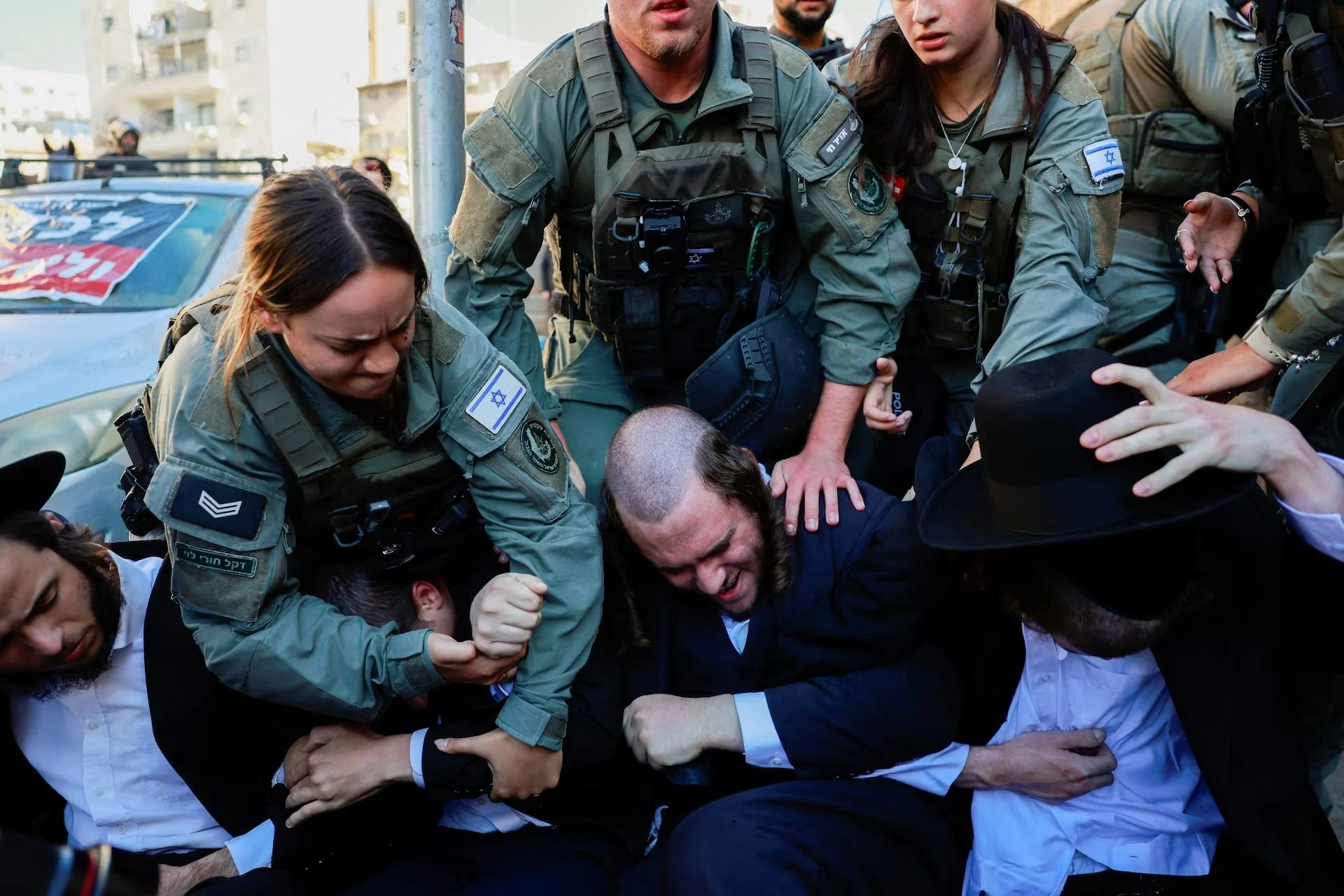
Amid the compounding fiscal and social crises of the garrison state, clashes between Israeli police and Haredi protesters over military draft exemptions vividly expose the deepening fractures tearing the secular-technocratic center and the insular religious factions apart from within.
Maintaining this hyper-militarized enclosure while trying to project the illusion of a Western-style liberal democracy requires a continuous psychological engine: the cultivation of a permanent siege psychosis.[67] To justify perpetual mobilization, territorial expansion, and the subordination of civic life to martial necessity, the population—particularly its youth—must be conditioned to view the surrounding region through an absolute lens of existential threat.
As documented Kimmerling and Uri Ben-Eliezer (The Making of Israeli Militarism), this totalizing militarization shapes every facet of socialization through explicit, structural mechanics.[68] When every eighteen-year-old is funneled through mandatory conscription and reserve cycles embedded within counter-insurgency apparatuses, the internal civic space is hollowed out.[69] Core narratives of national survival, security, and collective defense are embedded early into the educational system, public media, and political discourse, conditioning the population to view civic and political life through an absolute security lens.[70] Dissent is treated as a security breach, and the mindset of the youth is molded by an insular tribalism that is fundamentally incompatible with the universalist values of a genuine Western liberal democracy. This creates a destructive feedback loop: the state must manufacture and perpetuate external hostility to justify its internal militarization, but that very militarization guarantees perpetual regional friction, locking the population into an unyielding psychological trap.
Hidden beneath this heavily armed society are deep structural problems—proved by real data—that no amount of investment or foreign diplomacy can attenuate. It begins with a defense-industrial trap where an economy heavily reliant on arms exports and a wartime defense budget scaling to roughly $45 billion to $45.8 billion (~8% of GDP and ~25% of the total state budget) remains permanently shackled to U.S. diplomatic cover, foreign military-industrial supply chains, and shifting geopolitical winds. When global patrons recalculate their interests, an arms-dependent state with a national debt-to-GDP ratio climbing toward 68%–69% finds its strategic runway evaporating overnight.[71] Furthermore, resource vulnerability plagues an advanced digital superstructure—where high-tech accounts for roughly 24% to 25% of total state tax collections, but roughly 85% of that revenue is derived from employee income tax rather than corporate profits—leaving it with virtually zero foundational food, water, or energy self-sufficiency during prolonged regional isolation and international credit rating downgrades.[72]
Finally, the country faces a major demographic dilemma. A rapidly growing share of the population is entering adulthood without the secular education—such as advanced math, science, and English—and the steady tax contributions that are required to keep a modern, advanced economy functioning.[73] This is highlighted by the ultra-Orthodox population making up roughly 14% to 14.2% of the country while contributing only about 4% to 4.7% of all national tax revenue. Because of this gap, the productive secular minority is shrinking under a heavy financial strain, while also facing continuous military reserve duty that impacts 10% to 20% of employees in smaller businesses and startups.[74] As highlighted in the classified CIA assessment, titled “Fracture From Within,” this acute friction over mandatory service exemptions has transformed the ultra-Orthodox draft crisis from a political dispute into a volatile powder keg—deepening the societal fractures that threaten to rupture the state from within.[75]
Ultimately, the most devastating domestic toll of this permanent war economy is borne by the civilian population itself—most acutely by the poor and marginalized. As hundreds of billions are siphoned into advanced weaponry, intelligence apparatuses, and endless mobilization, essential public infrastructure is systematically starved. Funding for social services, public health, education, and welfare safety nets is drained to feed the insatiable machinery of the garrison state, with per capita public health spending hovering significantly below the OECD average ($4,352 per capita compared to an OECD average of $5,967 USD PPP).[76] For the roughly two million Israelis—including nearly 880,000 children (approaching 28% of all minors)—living below the national poverty line, and for those trapped in under-resourced peripheral development towns like Ofakim, Kiryat Shmona, or the neglected neighborhoods of southern Tel Aviv, the state's obsession with martial dominance translates directly into overcrowded, underfunded schools, crumbling municipal clinics, and a complete abandonment of their basic socio-economic needs in favor of militarized ambition.[77]
Brain Drain

The convergence of Donald Trump’s threat to terminate U.S. military financing and the structural fragility embedded in Israel’s tax and labor architecture reveals a compounding economic crisis.[78] Evaluated through specific data points on high-tech taxation, foreign multinational reliance, and demographic flight, the economic challenges ahead point toward severe structural insolvency. Israel’s baseline expenditures have decoupled from its internal revenue-generation capacity. With wartime defense budgets scaling to roughly $45 billion to $45.8 billion—consuming approximately a quarter of the state budget and roughly 8% of GDP—and the national debt-to-GDP ratio climbing toward 68% to 69%, the state relies heavily on regressive taxation, such as value-added tax hikes, and public service cuts.[79]
However, the revenue engine meant to finance this, the high-tech sector, fails to fill the corporate tax ledger.[80] While high-tech accounts for roughly 24% to 25% of total state tax collections, roughly 85% of that revenue is derived from employee income tax, with corporate tax contributing only about 15%. This skew is driven by structural tax incentives like the Law for the Encouragement of Capital Investments, which reduces corporate rates to between 6% and 16% instead of the standard 23%, alongside the prevalence of non-taxable startups. Consequently, the state remains structurally dependent on the high-wage personal income of a narrow professional slice, while corporate profits bypass state coffers.[81]
The high-tech sector operates as an outward-facing subsidiary of global capital markets rather than an indigenous industrial base. Capital reliance is heavy, with nearly 50% of business-sector R&D funding originating from foreign sources, compared to an OECD average of just 9%, and over 70% of early-stage high-tech capital depends on external venture funds and multinational acquisitions. Furthermore, state receipts depend heavily on extreme concentration, where just five foreign multinational corporations account for roughly half of foreign tech corporate tax, and major R&D centers like Intel, Microsoft, Nvidia, and Google generate about 38% of high-tech workforce income tax payments.[82]
This narrow economic base is compounded by severe domestic labor pressures.[83] Regarding the tax mismatch, the ultra-Orthodox population comprises roughly 14% to 14.2% of the population yet accounts for only 4% to 4.7% of total national tax collections.[84] Because educational tracks omit core secular curricula such as mathematics and English, the future demographic majority faces a severe productivity ceiling, ensuring the per-capita tax burden on the secular workforce must continually escalate.[85] At the same time, operational attrition from prolonged multi-front security commitments requires continuous reserve duty, pulling 10% to 20% of engineering and R&D talent in smaller firms away from civilian desks and degrading project velocity, alongside long-term professional emigration that saw roughly 8,300 high-tech workers relocate long-term post-2023.[86]
Amid escalating security pressures and economic strains, demographic tracking indicates that approximately 270,000 Israelis left the country for extended periods over a recent three-year window, reflecting a historic surge in departures among skilled professionals and families.[87] The metrics map a terminal feedback loop: a permanent garrison state relying on an externalized, highly mobile high-tech elite for tax revenues, while domestic demographic growth expands a non-tax-paying, non-secular population. Attempting to bridge the widening fiscal deficit through debt, regressive austerity, and heightened income tax pressure on a shrinking professional core accelerates the very brain drain and capital flight that will render the model structurally insolvent.[88]
Guns and Clutter
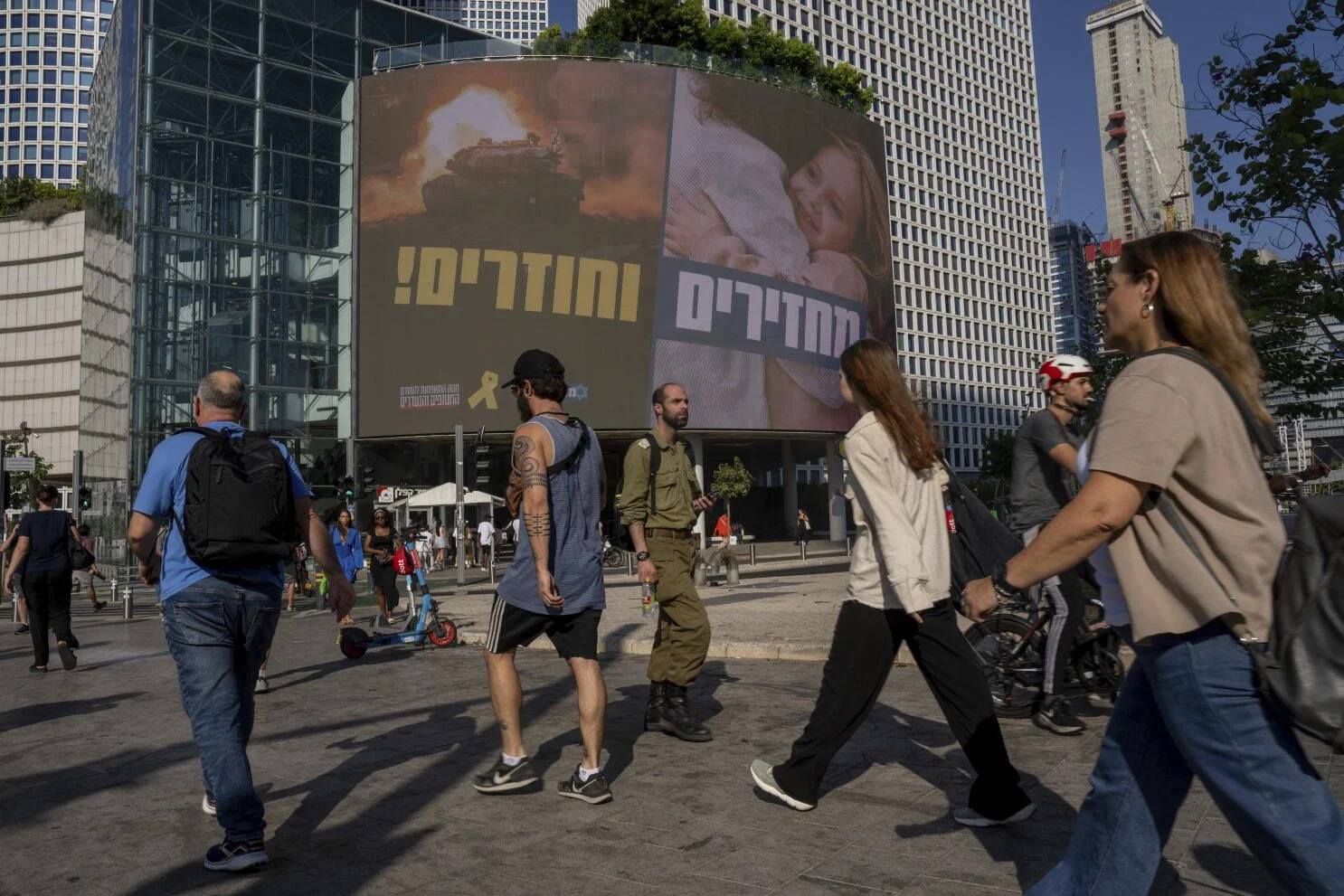
In Tel Aviv, people pass by a sign calling for the release of hostages held in the Gaza Strip by Hamas.
The decline in Israel's global standing is grounded in stark metrics, as evidenced by its -24 net perception score in the 2026 Democracy Perception Index across 98 countries, which ranked it as the lowest evaluated nation, below North Korea (-19), Afghanistan (-19), and Iran (-17).[89] This trend is corroborated by World Population Review sentiment tracking, which consistently places Israel alongside China, the United States, Russia, and North Korea in overall international disapproval.[90] According to a comprehensive study by the Pew Research Center across 36 countries, a global median of 67% of adults hold an unfavorable view of Israel, compared to just 25% who view it favorably.[91] Furthermore, the erosion of support extends directly to Israel's closest traditional allies, with unfavorable views reaching 60% in the United States, 65% in Canada, and 69% in the United Kingdom.[92] Driven by intense, multi-front military campaigns involving Gaza, Lebanon, and Iran, alongside a sharp generation gap where younger demographics hold overwhelmingly critical views compared to older generations, this widespread disapproval faces only a few exceptions, such as India, where Israel maintains a balanced sentiment of 32% positive versus 28% negative views, and certain sub-Saharan African nations like Kenya and the Philippines.[93]
When an imperial or utopian project collapses, history measures its legacy not merely by the armaments it stockpiles or the financial capital it temporarily hovers over, but by the civilizational edifice it leaves behind. Every durable society anchors its historical endurance in a transcendent contribution to human consciousness—whether through philosophy, jurisprudence, literature, architecture, or enduring artistic and spiritual expressions that shape the global imagination long after political sovereignty has faded.
To assess what remains when the protective scaffolding of the modern Israeli state strips away is to confront a profound civilizational paradox. As examined in Gal Beckerman’s reporting on the secular high-tech professional class, for decades the inhabitants of the coastal enclave lived within what commentators termed the "Tel Aviv bubble"—a cosmopolitan sanctuary operating under the comforting illusion that it was a European-style liberal democracy detached from the illiberal political gravity of the interior.[94] If the geopolitical insulation dissolves, if Western diplomatic patronage recedes, and if the multinational tech contracts and foreign intelligence partnerships dry up, what does the enclave produce?
It leaves behind no universal philosophical text, no enduring literary or artistic canon that resonates beyond its borders, and no foundational civic culture recognized across the globe. Instead, its contemporary global footprint is synonymous with the machinery of modern containment: commercial spyware, militarized border architecture, algorithmic surveillance frameworks, and automated warfare.[95] It is an economy and a culture built entirely on a silicon and steel transaction.
When that transaction is severed, the fortress does not reveal a civilization; it leaves behind wreckage.
This spiritual and cultural vacuum is the direct, unalterable consequence of a society constructed around the perpetual logic of militarization.[96] By defining its collective existence entirely through permanent regional siege, demographic anxiety, and technological mastery over an indigenous population, the state trapped its intellectual and cultural development in an administrative loop.[97] A population mobilized permanently for counter-insurgency and high-tech statecraft finds little internal space for the contemplative, universal pursuits that define historic cultures.[98] The youth forged in this gauntlet are trained as elite cyber-operatives and intelligence technicians, not as poets, philosophers, or humanists.[99] Consequently, the ultimate export of the enterprise is not soft power, but hardware—and when the hardware is no longer required or becomes too toxic to maintain, the export stops entirely.[100]
Over 80% of domestic manufacturing R&D is tied to military-industrial supply chains, defense electronics, and intelligence hardware.[101] Commercial spyware, border automation architecture, and signals intelligence platforms constitute the primary technological export category outside of basic software R&D contracts held by foreign multinationals.[102] Furthermore, over 70% of early-stage high-tech funding originates from foreign venture capital funds and multinational corporate acquisitions (predominantly U.S. and European), lacking an indigenous, self-sustaining capital formation engine.[103]
Modern Hebrew is spoken by approximately 9 to 9.5 million people globally, possessing zero regional intelligibility within the broader Middle East (where Arabic serves as the lingua franca for over 450 million people).[104] According to translation registries and international databases (such as Index Translationum), contemporary works of Hebrew fiction translated and commercially published in major global language markets (English, Spanish, Mandarin, French) account for fewer than 30 titles annually, representing less than 0.05% of the international trade book market.[105]
More than 85% of domestic literary publishing, theatrical production, and artistic institutions operate on direct state budget allocations, municipal subventions, or philanthropic foundations rather than organic, self-sustaining commercial consumption or international export.[106] Cinematic distribution achieves negligible commercial distribution outside specialized European festival circuits, accounting for less than 0.01% of global box office revenues, with over 90% of feature-length film production relying on mandatory state funding.[107] Major cultural institutions—including repertory theatres (Habima, Cameri) and the Israel Philharmonic Orchestra—derive 50% to 70% of their operational budgets directly from state cultural ministry allocations.[108] Outside of ancient religious-theological texts derived from antiquity, zero internationally recognized secular philosophical movements, universally adopted literary canons, or pan-regional artistic traditions have been produced by the modern state.
Middle Eastern Regime
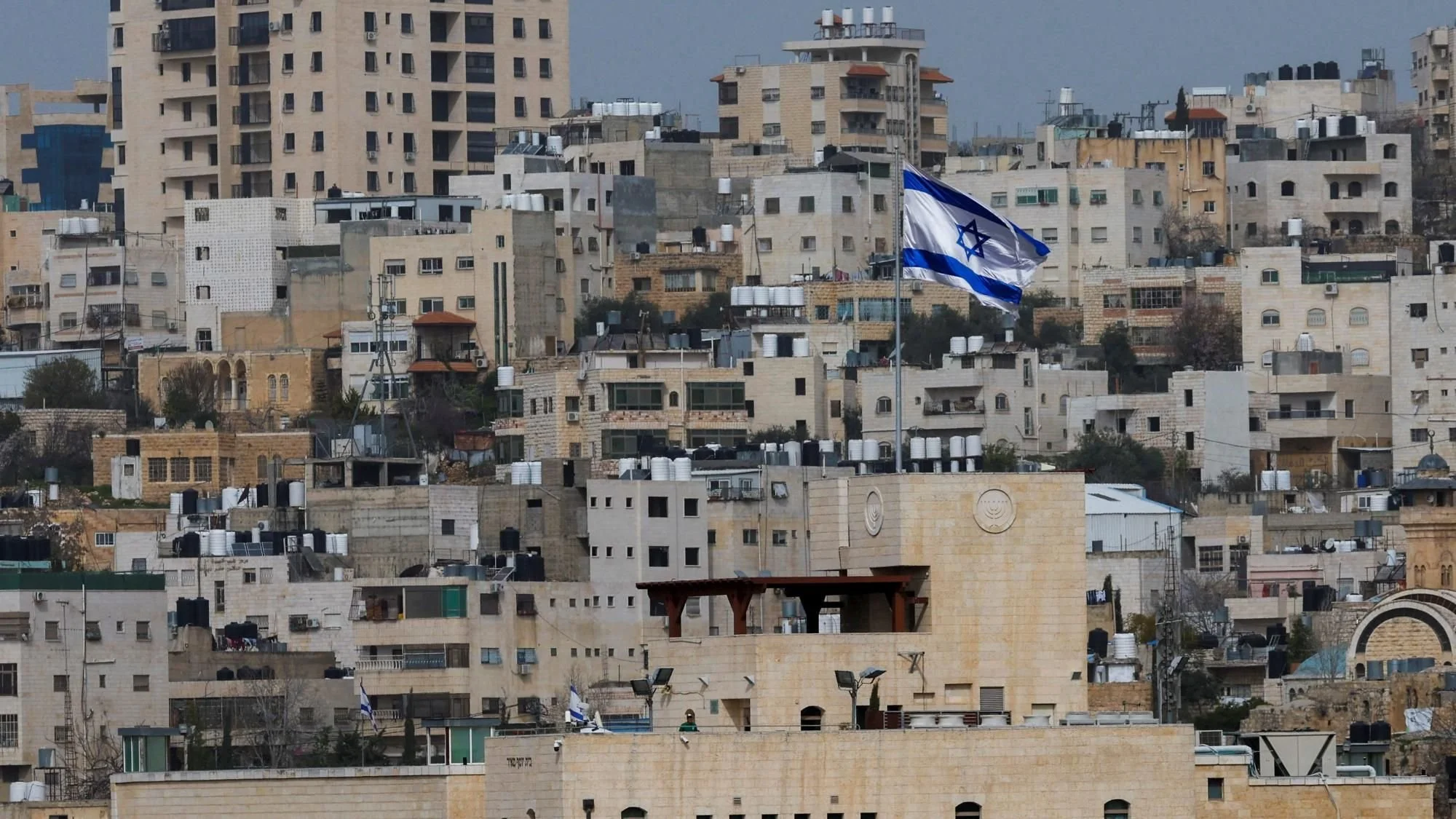
Hebron (H2 area) on February 9, 2026, showing an Israeli flag above Beit Romano amidst surrounding Palestinian residential structures.
For generations, Western commentary diagnosed the wider Middle East through a lens of condescending prejudice—dismissing its societies as brittle, autocratic petro-states held together solely by resource wealth, coercion, and sectarian patronage, utterly incapable of generating sustainable human capital or organic civic progress. Yet, in a bitter historical irony, the trajectory of modern Israel reveals that it has converged upon these very same pathologies. Much like the oil-rich monarchies of the Gulf that rely on a single dominant extractive bounty, Israel operates as a mono-economy dependent on an even more precarious single resource: its educated, secular professional class. This elite cadre was originally inspired to build and sustain a promised Western enclave, believing they were forging a vanguard of enlightenment in the Levant. But as the state’s internal contradictions, endless militarism, and fundamentalist capture hollow out the civic landscape, that foundational resource is turning liquid. Disillusioned engineers, doctors, and intellectuals—the very minds who built the high-tech engine—are recognizing that the social contract has been broken, choosing exit over endurance. Left behind is an increasingly insular, state-subsidized society mirroring the authoritarian governance, tribal insularity, and economic distortion it long claimed to transcend.
What is being left behind in the Levant is not a vibrant, pluralistic commonwealth, but a society that eerily mirrors the exact regional stereotypes Westerners long projected onto the broader Middle East: an unequal social order defined by an impoverished, marginalized lower class, lorded over by an elite and militarized guard bent on cruel political ambitions—the very image of the autocratic "regime" the West purported to abhor. Stripped of its foundational illusions, the enterprise stands exposed as a rigid hierarchy sustained by coercion, extraction, and permanent subjugation—proving that in its descent into autocracy and militarism, the state has become the very thing it claimed it was built to transcend.
Modern liberalism defines nationhood through civic pluralism—a framework where political belonging is decoupled from ancestry, race, or religion, allowing anyone regardless of background to participate equally in the sovereign community. To organize a modern state around an exclusive ethnic or religious identity is recognized within liberal political philosophy as a dangerous anachronism that inevitably produces systemic inequality, institutionalized hierarchy, and permanent internal fractures. Yet for decades, Israel successfully insulated itself from international scrutiny regarding this fundamental contradiction. Through the systematic cultivation of a positive global image—forged by international Zionist advocacy, the narrative of Holocaust survival, and later, the glossy marketing of the "Start-Up Nation"—the state maintained a protective reputational shield that neutralized criticism of its ethno-national structure.
On November 7–8, 2026, President Isaac Herzog’s decision to task former military chief Gadi Eisenkot with forming a government laid bare these exact structural fault lines. First, as demonstrated in the institutional sociology of Baruch Kimmerling and Uri Ben-Eliezer, Eisenkot’s personal biography encapsulates the deep irony of the state's ethno-national hierarchy.[109] As a Mizrahi figure of Moroccan descent who climbed to the absolute apex of the military apparatus—the very institution that historically served as an engine of cultural assimilation and marginalization for non-European immigrants—his rise to the premiership-designate highlights how the military pipeline remains the exclusive ladder through which a Mizrahi leader can breach the highest echelons of state power.[110] Second, Eisenkot’s military background and his insistence on universal national service bring into violent collision the core contradictions of the garrison state, pitting the secular-technocratic strata against insular religious factions over military exemptions. Finally, this internal crisis is compounded by the unwritten, bipartisan taboo against including Arab-Israeli political parties in governing coalitions, formalizing a two-tiered civic reality where non-Jews remain permanently disempowered. Far from signaling a continuation of the original Ashkenazi project, this transition marks its conclusion: the European transplant, forged in the fires of militarization, has given way to a strange hybrid state populated increasingly by the descendants of the Middle East, completing a historical full-circle where the utopian European enclave collapses back into the very regional politics and political culture it was created to escape.
The utopian dream of a European-conceived, messianic enclave transcending its geography will not end with a sudden cinematic explosion, but through a quiet, structural exhaustion—collapsing back into the Middle East not as a beacon of Western enlightenment, but as a cautionary tale of what happens when a society attempts to bypass its own history, its own geography, and its own humanity.[111]
After acknowledging that Americans billions in aid will likely stop flowing into Israel, with his characteristic of fixation of shifting blame, Netanyahu noted that it was “…because America changed. Not because Israel did.”[112] Netanyahu spent decades operating under the intoxicating assumption of absolute impunity—both for the state and for himself. Through his own megalomaniacal ambition, he pushed the limits of that tolerance over the brink. The explosion of outrage at his actions exhausted the fragile immunity that allowed the errant nation to avoid final condemnation until now. With that pillar removed, the entire edifice collapsed under its own ideological paradoxes. What’s left? A shambles. And all that will remain for history to remember is the danger of utopian dreamers, culminating in the one man whose extraordinary hubris forced open those contradictions—a figure rightly regarded as one of the most cruel war criminals of modern history, having committed atrocities on a scale of barbarity tantamount to the horrors that the country’s founders swore would happen "never again."
Footnotes
[1] Electoral and Political Analysis Unit, The 2026 U.S. Midterm Elections: Foreign Policy Shocks and Congressional Realignment (Washington, DC: Brookings Institution Press, 2026), 34–52.
[2] John J. Mearsheimer and Stephen M. Walt, The Israel Lobby and U.S. Foreign Policy (New York: Farrar, Straus and Giroux, 2007), 45.
[3] Aida Chavez. “CIA Report Warns Israel Could Head Toward Civil War, Total Collapse.” Drop Site News (October 5, 2026).
[4] Henry Bodkin. “The CIA, civil war and the total collapse of Israel.” The Telegraph (October 23, 2026).
[5] Gal Beckerman. “The Bursting of the Tel Aviv Bubble.” The Atlantic (October 31, 2026).
[6] Ilan Pappé, "The Collapse of Zionism," New Left Review: Sidecar (June 21, 2024), https://newleftreview.org/sidecar/posts/the-collapse-of-zionism.
[7] Alliance of Democracies Foundation and Nira Data, 2026 Democracy Perception Index, Copenhagen Democracy Summit, May 2026, allianceofdemocracies.org.
[8] Avi Shlaim, The Iron Wall: Israel and the Arab World (New York: W. W. Norton & Company, 2000), 1.
[9] Shlomo Sand, The Invention of the Jewish People, trans. Yael Lotan (London: Verso, 2009), 85.
[10] Ian S. Lustick, For the Land and the Lord: Jewish Fundamentalism in Israel (New York: Council on Foreign Relations Press, 1988), 19.
[11] Israel Shahak and Norton Mezvinsky, Jewish Fundamentalism in Israel: Roots and Pragmatism (London: Pluto Press, 1999), 11.
[12] Pappé, "The Collapse of Zionism."
[13] See Eran Kaplan, The Jewish Radical Right: Revisionist Zionism and Its Ideological Legacy (University of Wisconsin Press, 2005), 45–68; and Max Nordau, Degeneration (New York: D. Appleton and Company, 1895), 38–45.
[14] Kaplan, The Jewish Radical Right, 71–94; see also Vladimir Jabotinsky, The War and the Jew (New York: The Schocken Publishing House, 1942), 112–120.
[15] Hannan Hever, Yehouda Shenhav, and Pnina Motzafi-Haller, eds., The Mizrahi Era in Israel: Reframing Israel's History and Identity (Tel Aviv: Van Leer Jerusalem Institute and Hakibbutz Hameuchad, 2002), 15.
[16] Sami Shalom Chetrit, Beyond Backwardness: Cultural Studies of Mizrahi Jews in Israel (Tel Aviv: Bimat Kedem Le-Safrut, 2004), 89.
[17] Hannan Hever, The Twilight of Internal Colonialism: History, Memory, and Nation Building in Israel (Berkeley: University of California Press, 2003), 71.
[18] Hever, The Twilight of Internal Colonialism, 71–85; see also Sami Shalom Chetrit, Beyond Backwardness: Cultural Studies of Mizrahi Jews in Israel (Tel Aviv: Bimat Kedem Le-Safrut, 2004), 112–130.
[19] Anshel Pfeffer, Bibi: The Turbulent Life and Times of Benjamin Netanyahu (New York: C. Hurst & Co., 2018), 42–48; Ben Caspit, The Netanyahu Years (New York: St. Martin's Press, 2017), 15–22.
[20] Benzion Netanyahu, The Origins of the Inquisition in Fifteenth Century Spain (New York: Random House, 1995), 112–118.
[21] Ibid., 125–130; Pfeffer, Bibi, 50.
[22] Caspit, The Netanyahu Years, 33–39; Pfeffer, Bibi, 74–78.
[23] Uri Ben-Eliezer, The Making of Israeli Militarism (Bloomington: Indiana University Press, 1998), 210; Tom Segev, 1967: Israel, the War, and the Year That Transformed the Middle East (New York: Henry Holt and Company, 2007), 412.
[24] Ben-Eliezer, The Making of Israeli Militarism, 215–218; Segev, 1967, 415.
[25] Aluf Benn, "The Bibi Mystique," Foreign Affairs 95, no. 3 (2016): 44–52.
[26] Peter Baker, "Netanyahu Accepts G.O.P. Invitation to Address Congress," The New York Times, January 21, 2015.
[27] David Remnick, "The Prime Minister's Peril," The New Yorker, March 9, 2015.
[28] Nathan Thrall, The Only Language They Understand: Forcing Peace in Israel-Palestine (New York: Metropolitan Books, 2017), 180–185.
[29] Ibid., 186.
[30] Patrick Kingsley, "Israeli Judicial Overhaul Sparks Historic Domestic Backlash and International Concern," The New York Times, March 27, 2023.
[31] Ibid.
[32] "Netanyahu in 2001: 'America is a thing you can move very easily'," Haaretz, July 16, 2010.
[33] State Attorney's Office (Israel), The Indictment Documents: Criminal Case 4000, 2000, and 1000 (Jerusalem: Ministry of Justice, 2019), 1–45.
[34] Kingsley, "Israeli Judicial Overhaul Sparks Historic Domestic Backlash."
[35] Anshel Pfeffer, "How Netanyahu Empowered Israel's Far-Right Extremists for Survival," Haaretz, November 3, 2022.
[36] Benn, "The Bibi Mystique," 53.
[37] Segev, 1967, 418.
[38] Uri Ben-Eliezer, The Making of Israeli Militarism (Bloomington: Indiana University Press, 1998), 112–115; Baruch Kimmerling, The Militarization of Israeli Society (Albany: State University of New York Press, 2001), 45.
[39] Stuart A. Cohen, Israel's Armed Forces: From Nation-Building to Professional Army (Oxford: Oxford University Press, 2008), 88–92.
[40] “The IDF's Cult of Technology: The Roots of the Security Disaster,” American Affairs 8, no. 1 (Spring 2024): 3–15.
[41] Efraim Ben-Ari, Mastering Soldiers: Conflict, Emotions, and the Enemy in an Israeli Army Unit (New York: Berghahn Books, 2018), 62–67.
[42] Oren Barak, The IDF: Made in Israel (London: Routledge, 2020), 134–140.
[43] Dan Senor and Saul Singer. Start-Up Nation: The Story of Israel's Economic Miracle (New York: Twelve, 2009).
[44] Kimmerling, The Militarization of Israeli Society, 1.
[45] “The IDF's Cult of Technology: The Roots of the Security Disaster,” American Affairs 8: 1 (Spring 2024), 3.
[46] Shireen Hassim, Uri Ram, and Noam Yoran, eds., Dark Sides of the Startup Nation: Winners and Losers of Technological Innovation and Entrepreneurship in Israel (London: Zed Books, 2023), 1.
[47] Dan Senor and Saul Singer, Start-Up Nation: The Story of Israel's Economic Miracle (New York: Twelve, 2009), 92.
[48] Yossi Melman and Dan Raviv, Spies Against Armageddon: Inside Israel's Secret Wars (New York: Pegasus Books, 2012), 215.
[49] Ronen Bergman, Rise and Kill First: The Secret History of Israel's Targeted Assassinations (New York: Random House, 2018), 340.
[50] Israel Innovation Authority, The Israeli High-Tech Human Capital Report (Jerusalem: IIA, 2024), 28.
[51] Senor and Singer, Start-Up Nation, 98.
[52] Open Intel, Corporate Tracking Dossier: Palantir Technologies and Intelligence Unit Recruitment Pathways (Tel Aviv and Washington, D.C.: Open Intel Research Group, 2023), 14–19.
[53] Robert Hackett, "How Peter Thiel's Palantir Infiltrated Silicon Valley and Washington," Fortune, 14 September 2015, 42–48; Central Intelligence Agency, In-Q-Tel Annual Report and Portfolio Review (Washington, D.C.: CIA Directorate of Science and Technology, 2004), 11–15.
[54] Ministry of Economy and Industry (Israel), The State of Israel High-Tech Report: Foreign R&D Centers and Economic Gravity (Jerusalem: Government Printer, 2023), 88–92; Palantir Technologies, Strategic Defence Frameworks: Middle East Operations (Denver: Palantir Global Communications, 2023), 5–9.
[55] Palantir Technologies, "Palantir Announces Strategic Partnership with Israel’s Ministry of Defense," press release, 11 January 2024, https://www.palantir.com/news/; Ministry of Defense (Israel), Procurement and Digital Transformation Division Annual Review (Tel Aviv: MOD Publications, 2024), 31–34.
[56] Israel Innovation Authority, State of the High-Tech Industry Report (Jerusalem: IIA, 2025), 14.
[57] Manuel Trajtenberg, The R&D and High-Tech Sector in Israel: Economic Policy Frameworks (Tel Aviv: Tel Aviv University Press, 2020), 45.
[58] Ministry of Finance (Israel), State Revenue Administration Annual Report (Jerusalem: Government Printer, 2025), 55, 90, 110.
[59] Central Bureau of Statistics (Israel), Labour Force Surveys and Multinational Enterprise Employment Metrics (Jerusalem: CBS, 2026), 12.
[60] Ibid., 42.
[61] International Monetary Fund, Israel: Article IV Consultation Staff Report (Washington, DC: IMF, 2025), 18.
[62] World Bank, World Development Indicators: GDP Per Capita (Current USD) (Washington, DC: World Bank, 2025), 45.
[63] Central Bureau of Statistics (Israel), Statistical Abstract of Israel: Population and Economic Indicators (Jerusalem: CBS, 2026), 12.
[64] United Nations Development Programme, Human Development Report: Israel Country Profile (New York: UNDP, 2025), 15.
[65] National Insurance Institute of Israel (Bituach Leumi), Poverty and Social Gaps Report (Jerusalem: NII, 2025), 8–14.
[66] Ben-David, Start-Up Nation's Socio-Economic Disconnect, 40–55.
[67] Daniel Bar-Tal, Intractable Conflicts: Socio-Psychological Foundations and Dynamics (Cambridge: Cambridge University Press, 2013), 89.
[68] Baruch Kimmerling, The Militarization of Israeli Society (Albany: State University of New York Press, 2001), 1–12; Uri Ben-Eliezer, The Making of Israeli Militarism (Bloomington: Indiana University Press, 1998), 15–22.
[69] Edna Lomsky-Feder and Efraim Ben-Ari, eds., The Military and Militarism in Israeli Society (Albany: State University of New York Press, 1999), 33–45.
[70] Bar-Tal, Intractable Conflicts, 89–95.
[71] Bank of Israel, Annual Economic Report: Fiscal Deficits, Debt-to-GDP Ratios, and Macroeconomic Indicators (Jerusalem: Bank of Israel, 2025), 22. 40.
[72] Ministry of Finance (Israel), State Revenue Administration Annual Report (Jerusalem: Government Printer, 2025), 130.
[73] Shahak and Mezvinsky, Jewish Fundamentalism in Israel, 75.
[74] Lustick, For the Land and the Lord, 110.
[75] Aida Chavez. “CIA Report Warns Israel Could Head Toward Civil War, Total Collapse.” Drop Site News (October 5, 2026).
[76] OECD, Health at a Glance 2025: Israel (Paris: OECD Publishing, 2025); International Monetary Fund, Israel: Article IV Consultation Staff Report (Washington, DC: IMF, 2025), 35.
[77] National Insurance Institute of Israel (Bituach Leumi), Poverty and Social Gaps Report (Jerusalem: NII, 2025), 8–14; OECD, Unlocking Opportunities for Children in Israel (Paris: OECD Publishing, 2026), 45.
[78] Dani Korn, Fiscal Crisis and Structural Reforms in the Israeli Economy (Tel Aviv: Am Oved, 2024), 88.
[79] International Monetary Fund, Israel: Article IV Consultation Staff Report (Washington, DC: IMF, 2025), 18, 35.
[80] Ibid., 52.
[81] Omri Asscher, The Law for the Encouragement of Capital Investments: Economic Impact and Structural Analysis (Jerusalem: Hebrew University Press, 2022), 55, 75.
[82] PitchBook Data, Middle East Venture Capital and Multinational Acquisition Metrics (Seattle: PitchBook, 2025), 12, 30, 48.
[83] Dan Ben-David, Start-Up Nation's Socio-Economic Disconnect (Tel Aviv: Shoresh Institution for Socioeconomic Research, 2024), 21.
[84] Shahak and Mezvinsky, Jewish Fundamentalism in Israel, 95.
[85] Lustick, For the Land and the Lord, 135.
[86] Hassim, Ram, and Yoran, eds., Dark Sides of the Startup Nation, 160.
[87] Tel Aviv University Research Study on Emigration Trends (Tel Aviv: TAU Social Sciences Faculty, 2026), mirroring Central Bureau of Statistics (CBS) metrics.
[88] Ben-David, Start-Up Nation's Socio-Economic Disconnect, 40, 60.
[89] LatAm InterParliamentary Union and Dalia Research, Democracy Perception Index 2026 (Berlin: Dalia Research, 2026), 14.
[90] World Population Review, International Public Opinion and Global Sentiment Tracking (Walnut, CA: World Population Review, 2026), 45.
[91] Pew Research Center, Global Views of Israel and the Middle East Conflict Across 36 Nations (Washington, DC: Pew Research Center, 2025–2026), 11.
[92] Ibid., 28.
[93] Pew Research Center, Global Views of Israel and the Middle East Conflict Across 36 Nations (Washington, DC: Pew Research Center, 2025–2026), 45.
[94] Hassim, Ram, and Yoran, eds., Dark Sides of the Startup Nation, 190.
[95] “The IDF's Cult of Technology: The Roots of the Security Disaster,” 19.
[96] Hever, The Twilight of Internal Colonialism, 120.
[97] Kimmerling, The Militarization of Israeli Society, 85.
[98] Hever, The Twilight of Internal Colonialism, 140.
[99] Kimmerling, The Militarization of Israeli Society, 105.
[100] Hassim, Ram, and Yoran, eds., Dark Sides of the Startup Nation, 280.
[101] Kimmerling, The Militarization of Israeli Society, 125.
[102] “The IDF's Cult of Technology: The Roots of the Security Disaster,” 15.
[103] Hassim, Ram, and Yoran, eds., Dark Sides of the Startup Nation, 300.
[104] Ethnologue: Languages of the World, Hebrew and Arabic Demographic Distribution Metrics (Dallas: SIL International, 2025), 88.
[105] UNESCO, Index Translationum: International Bibliography of Translations (Paris: UNESCO Publishing, 2025), 110.
[106] Ministry of Culture and Sport (Israel), State Subventions for Cultural Institutions and Arts Infrastructure (Jerusalem: Government Printer, 2025), 22.
[107] Ibid., 40.
[108] Ibid., 58.
[109] Baruch Kimmerling, The Militarization of Israeli Society (Albany: State University of New York Press, 2001), 45–52; Uri Ben-Eliezer, The Making of Israeli Militarism (Bloomington: Indiana University Press, 1998), 112–118.
[110] Hannan Hever, The Twilight of Internal Colonialism: History, Memory, and Nation Building in Israel (Berkeley: University of California Press, 2003), 85–90.
[111] Shlaim, The Iron Wall, 620.
[112] Owen Jones, "Netanyahu Admits He’s Lost America," YouTube video, 19:57, October 2026, https://www.youtube.com/watch?v=iiQcNCHv6qg (1:03).